Start with the follow-up problem, not the app
When a quote is waiting for a decision, the challenge may be simple: it is hard to see what has happened, who is responsible for the next step, or what information is missing. A first app plan can turn that uncertainty into a clear business workflow. The aim is not to begin with a long feature list. It is to describe one real quote journey and identify what a useful tool would need to help your team manage it. This approach can help business owners who have an idea for software but are unsure how to move from a prototype or rough concept to a dependable business tool. Begin with questions your team can answer without technical knowledge: What starts the process? What should be recorded? Who needs to act? What does the business need to know before deciding what to do next? KAXXIS provides a licensed runtime and Module SDK, while business modules supply project-specific screens, workflows, data models and integrations. In plain terms, the module is where a particular business process is shaped into software. Catalogue examples are not finished applications included automatically, so a quote-follow-up tool would need to be discussed and scoped for the business's needs.
Turn the real process into a small, testable brief
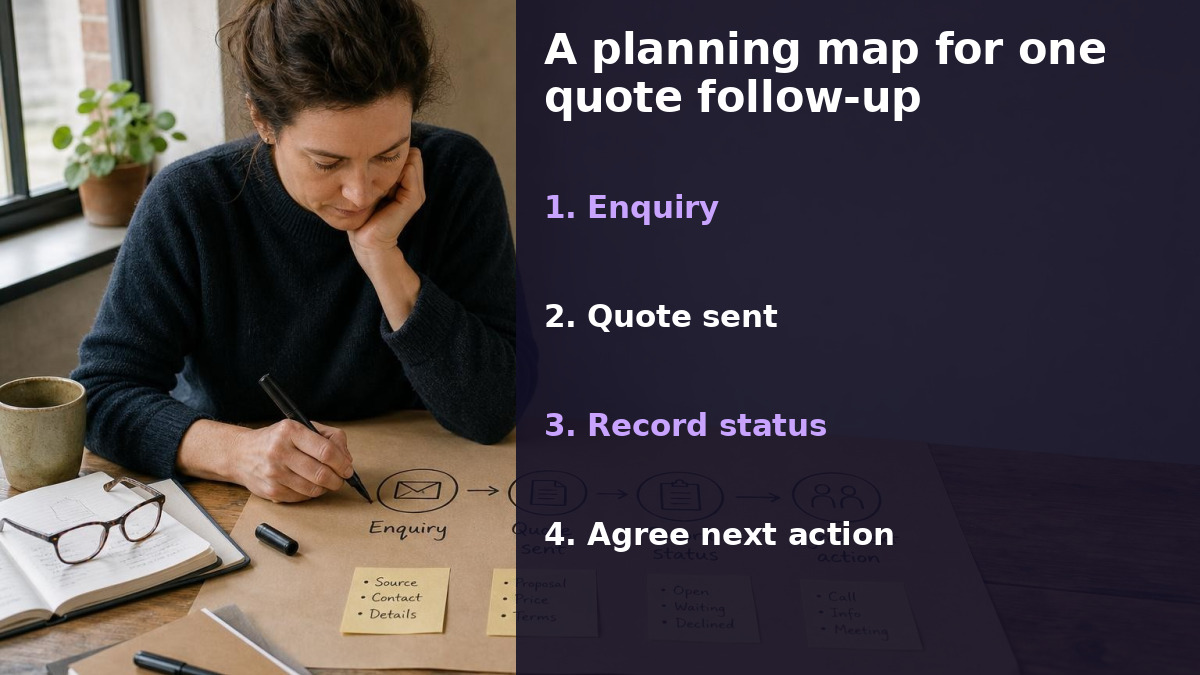
Choose one recent quote and trace it from enquiry to decision. Keep the first plan narrow: capture what staff actually need to know, rather than assuming the app should automate everything. A simple brief might describe the quote information to record, the people responsible for updating its status, and the next action the business wants to see. Separate essential needs from ideas to explore later. For example, a business might first want a clear record of whether a quote is awaiting a response, has been accepted, or needs another action. Those are planning prompts, not claims about a ready-made KAXXIS quote feature. If the process requires connections to payment services or other external providers, make those needs explicit for scoping. A useful brief also describes how the team will know whether the proposed workflow makes sense. Ask the people who handle quotes to review the steps. Check that each status has a clear meaning and that someone knows what to do next. This helps turn a general idea into something that can be discussed and validated before committing to a larger build.
- What information about a quote must be recorded?
- Who can update its status, and what should happen next?
- Which needs are essential for a first version, and which can wait?
Illustrative example: map one quote from enquiry to decision
Illustrative planning example—not a finished KAXXIS feature: a small business takes a quote that has been sent and maps the steps its team wants to follow. The team could list the information it needs to find the quote, the status it needs to record, who is responsible for checking it, and what decision or next action should be visible. The point is to agree the workflow before treating it as a software specification. The business could then review the proposed screens and information with the people who would use them. If different customers or business tenants use the system, access also needs attention: the KAXXIS developer walkthrough calls for tenant-scoped record queries and tests that one tenant cannot read or update another tenant's records. That is a relevant validation question for a multi-tenant application, not a promise that a particular quote module is already built.
Validate the plan, then discuss scope
Before moving from an idea to a build, use a short review to find gaps and assumptions. A plan becomes more useful when the business can explain the workflow, the information it relies on, and who needs access. If you are working with AI while shaping an idea or prototype, treat its output as a draft to check with the people who understand the process—not as proof that the workflow is complete. KAXXIS modules are project-specific, rather than automatically included quote applications. Hosting, external provider usage, payment integrations and bespoke development are separately configured or scoped. Deployment scope, support and updates are agreed in the proposal. Those boundaries matter because they help define what the project includes before you rely on it in day-to-day work. A practical next step is to write down one real quote journey and mark the information, status, owner and next action at each point. Then discuss whether a scoped business module fits the workflow and what would need to be agreed. A clear first plan gives you a more useful starting point than a broad request to “build an app”—and a concrete basis for deciding what to explore next.
- Trace one real quote from enquiry through its current outcome.
- List the information, status, responsible person and next action at each step.
- Ask users to check the plan and identify unanswered requirements.
- Discuss module scope, hosting, integrations, deployment, support and updates before relying on a proposed solution.