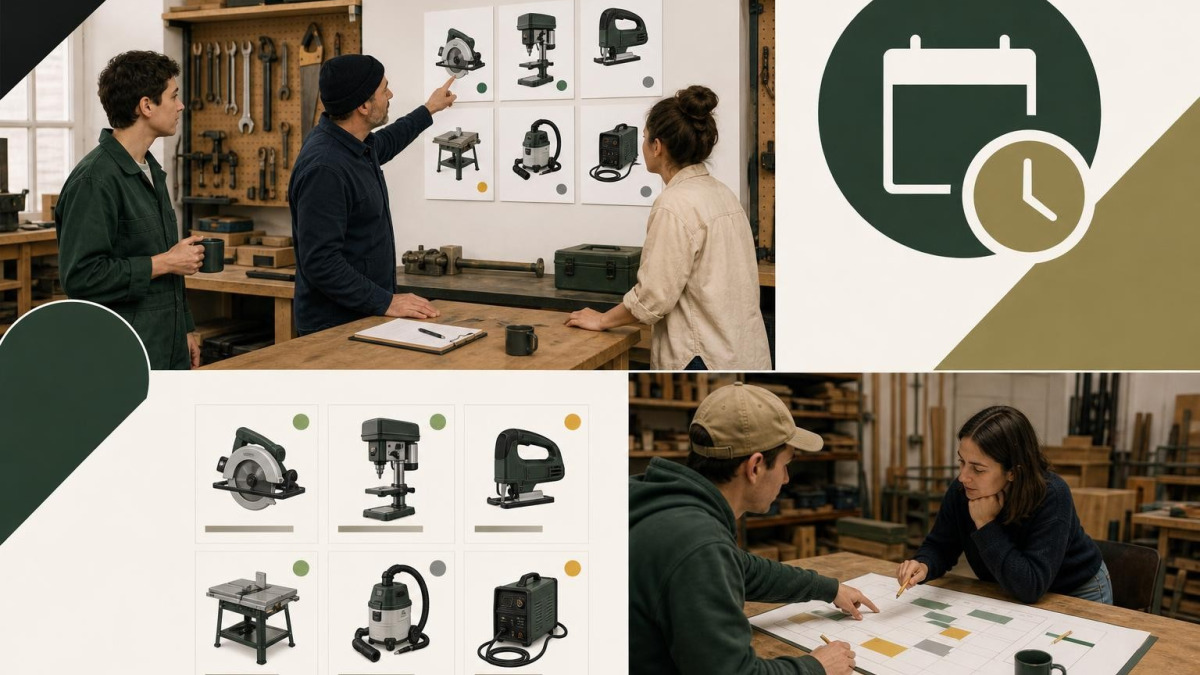
What could a shared-equipment app help a community workshop do?
Community workshops often have tools and equipment that many members need to share. A booking application built for that niche could give members a place to check availability and coordinate reservations, rather than relying on scattered messages or informal arrangements. The value is in solving that particular group’s practical problem: helping people find and reserve the equipment they need. This is an illustrative build concept, not a finished KAXXIS application. You might propose features such as an equipment list, availability views and reservation requests, then decide what screens and rules the workshop actually needs. That focus on a defined audience and a concrete task can make an app idea easier to discuss and develop than a broad promise to serve everyone.
How could KAXXIS support turning the concept into an application?
KAXXIS provides a modular SaaS platform foundation and a build kit to help creators build, license, translate, deploy and upgrade an application. The project-specific module supplies the screens, workflows, data model and integrations for the particular application. For this example, that means the booking experience would need to be created for the workshop’s requirements; platform catalogue examples are not finished applications automatically included with a licence. KAXXIS describes its platform for developers, agencies and ambitious businesses, and invites visitors to explore what is already built and how modules deploy. The useful distinction is that the platform provides a foundation and build path, while the niche product idea shapes the module. Vibe coding may be one approach to developing that module with compatible tools; it does not mean the platform automatically generates this booking app or that the app itself must include AI features.
What would you need to decide before building the first version?
Start with the workshop’s actual reservation problem, then turn it into a small set of requirements. For instance, agree who can view availability, who can request or manage a reservation, and what information the workshop needs to keep. These are questions for defining the proposed app, not claims about features already supplied by KAXXIS. If the app serves more than one workshop or customer group, think early about keeping each group’s records separate. KAXXIS’s developer walkthrough calls for access checks and tenant-scoped record queries, and recommends testing that one tenant cannot read or update another tenant’s records. That is a practical reminder that a useful customer-facing product needs thoughtful data access, not just a promising interface. The walkthrough also recommends building the unmodified starter before making changes, so environment problems can be separated from issues introduced by later code changes. For modules on a managed host, an authorised operator stages a reviewed release through Package Manager, and a controlled host restart activates it. Module code runs in-process and needs review.
- Name the specific users and equipment-sharing problem.
- List only the first-version screens, reservation steps and data the workshop needs.
- Decide who can access and change records, then plan tests for separation between customer groups.
- Explore the documented build and deployment path before committing to a proposed release process.
What is the next step for exploring this opportunity?
A useful starting point is a short product outline: who the app serves, what reservation task it improves, and which few features would make a first version useful. That outline can guide a conversation about the project-specific module and the relevant deployment approach. In a Nov. 4, 2026 post on X, Jerry Liu argued that coding agents could give startups leverage to compete. The surrounding discussion also raised the challenge of securing and maintaining software. These are external opinions, not KAXXIS product claims; for a niche app, the practical takeaway is to pair an ambitious idea with deliberate requirements and review. KAXXIS’s platform page describes a licensed runtime and Module SDK; deployment scope, support and updates are agreed in the proposal. Explore what is already built and how modules deploy to see whether the build-and-deploy path fits your application idea.
News sources
- i agree that vibe-coded solutions will not replace enterprise-grade saas … — published 2026-11-04T01:20:31+00:00
- Webflow vs Vibe Coding: Which Is Better for a B2B SaaS Website? | ViDesigns – Webflow Agency — published 2026-10-26T12:22:30+00:00