Start with the decision, not the feature list
A useful stock-reorder tool should help someone make a clear decision: does this item need review, and who should decide what happens next? Starting there gives a business owner a practical way to shape an idea before discussing screens or technology. It also helps keep a first release focused on one real business situation rather than trying to automate every stock task at once. Write down what currently prompts a person to check an item, what information they look at, and what decision follows. The answer might be a scheduled review, a particular stock condition, or another rule used by the business. Treat that as a question to confirm with the people who handle reordering—not as a feature that is already built. A software plan should reflect the business’s actual process, including who can make or approve a decision.
- What should prompt someone to review an item?
- Who checks the information and who makes the reorder decision?
- What should happen after the decision?
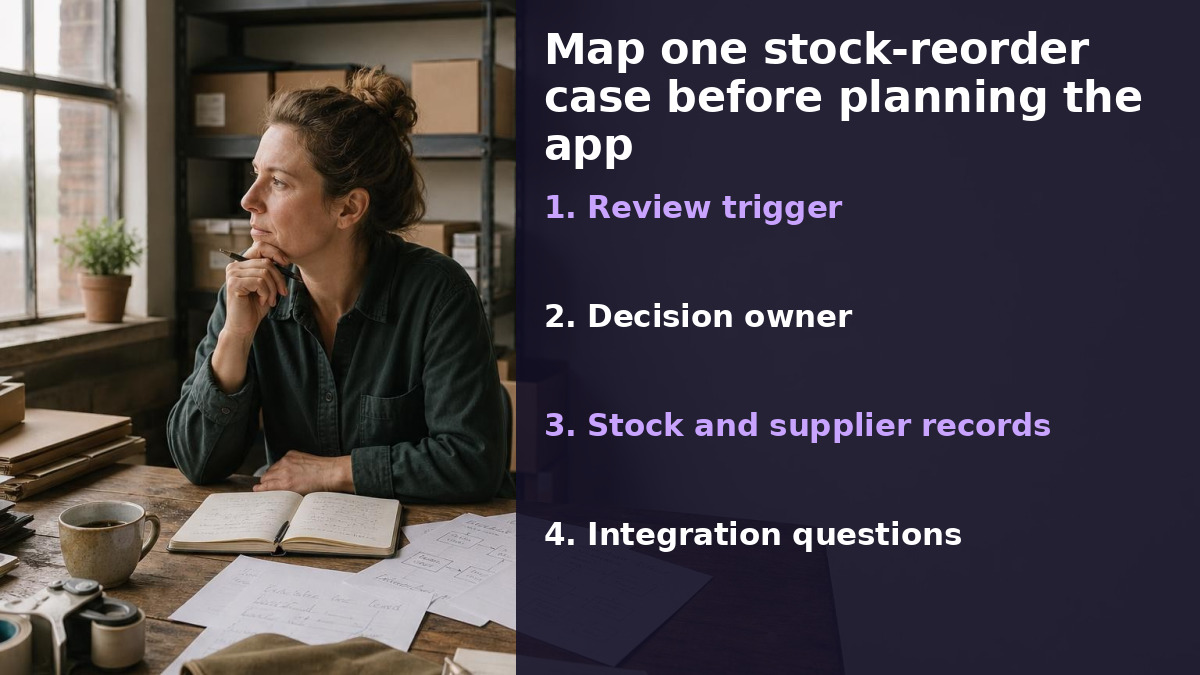
Illustrative example: map one reorder case
Imagine a small business wants a tool to help staff decide when to review an item. This is a planning example, not a description of a ready-made KAXXIS feature. The business could first agree what event should prompt a review, such as a staff member noticing that an item needs attention. It would then identify the decision owner, the stock and supplier records needed to make the call, and any other system that might need to provide or receive information. Questions could include: Which record is the source of truth? Who can change it? Is an integration actually needed for the first release, or can the process begin with information entered or checked another way? Those answers become a small, testable scope for discussion. They also reveal where assumptions need checking with staff before anyone spends time building screens or connecting systems. The exact screens, workflow, data model and integrations are project-specific decisions, not a stock-reorder package included automatically with the platform.
- Trigger: what event should start a review?
- Owner: who checks the case and decides what to do?
- Records: what stock and supplier information is needed?
- Integration questions: which other systems, if any, must be involved?
Know what the platform provides—and what must be scoped
KAXXIS provides a licensed runtime—the environment for running an application module—and a Module SDK, the tools used to create one. Business modules supply the project-specific screens, workflows, data model and integrations. Catalogue examples can help illustrate possibilities, but they are not finished applications automatically included in a licence. For a stock-reorder idea, that means the business process still needs to be defined and the required module work agreed. This distinction helps a new creator ask a practical question: what is already part of the platform, and what does this particular application need? Hosting, external-provider usage, payment integrations and bespoke development are separately configured or scoped. Deployment scope, support and updates are agreed in the proposal. These are matters to discuss for the project; they should not be assumed from the idea alone.
Turn the idea into a first-release conversation
Before asking for an estimate or planning a prototype, write one real reorder case in everyday language. Include the situation that prompts review, the person responsible, the records they consult, and the decision they need to make. Mark anything uncertain as a question. This gives a business discussion a concrete starting point and helps separate essential requirements from later possibilities. If the tool will serve separate businesses or tenants, ask how their records must be kept apart. The KAXXIS developer walkthrough calls for tenant-scoped record queries and testing that one tenant cannot read or update another tenant’s records. A first-release plan should include that kind of requirement where it applies. There are also technical review considerations: on a managed host, an authorised operator stages a reviewed module release, and a controlled host restart activates it. Module code is trusted code running within the host, so it needs review. These details may make expert input appropriate for implementation and release planning. A useful next step is to document one real reorder case and discuss its scope: the workflow, the people and records involved, any necessary integrations, and the deployment arrangements to agree. That conversation can establish what belongs in a first release without assuming the platform already contains the finished application.
- Describe one real reorder situation from prompt to decision.
- Name the decision owner and list the records they need.
- Identify uncertain rules, data sources and possible integrations.
- Ask what security, deployment and specialist review the project needs.