Start with the result you want
A useful quote-follow-up tool starts with a clear goal: help your team record each quote, understand what has happened since it was sent, and decide what needs attention next. Before choosing screens or technology, describe the work your team wants to make easier. That gives you a practical brief to discuss, rather than a broad idea like “an app for quotes.” KAXXIS supplies a licensed runtime and Module SDK as a starting point for building business applications. The business-specific screens, workflows, data model and integrations are supplied through project-specific modules; catalogue examples are not finished applications automatically included in the licence. So the first planning task is to describe the quote process you want a project to support.
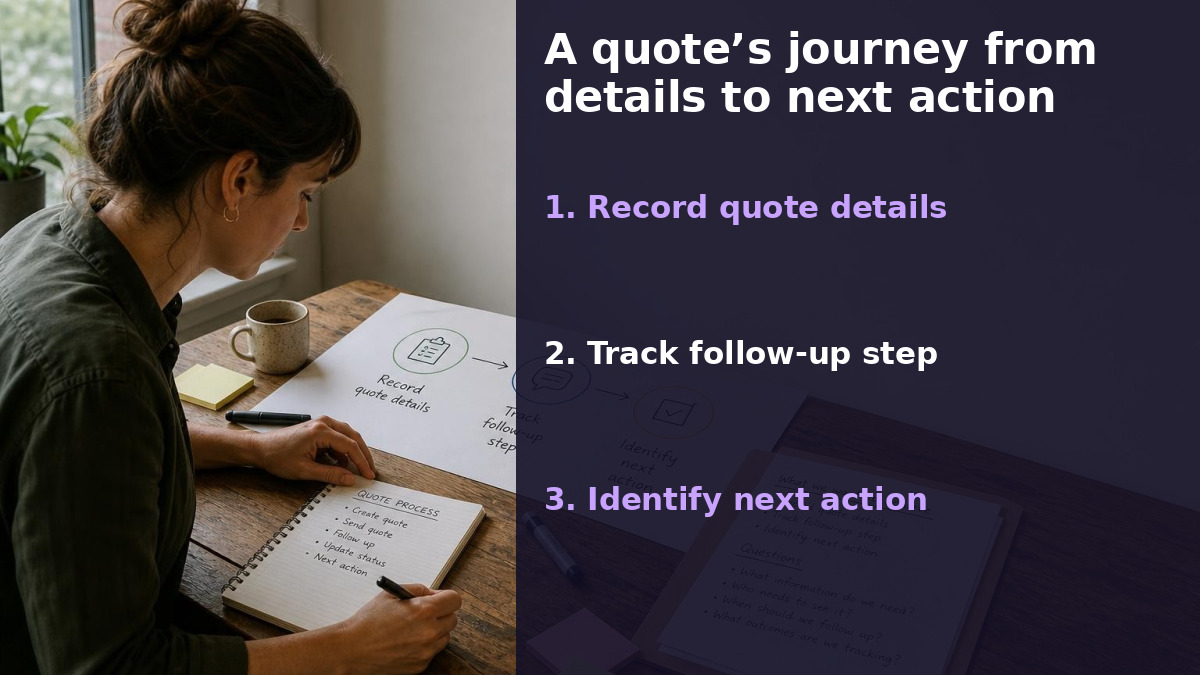
Illustrative example: map one quote from start to next step
Imagine a small team that wants a shared way to follow a quote from preparation through follow-up. This is an illustrative planning example, not a ready-made KAXXIS feature. On paper, map the steps the team actually follows. For each step, ask what information someone needs to record and what they should be able to see next. A possible outline might be: record the customer and quote details; note when and how it was sent; update the follow-up status after contact; and identify which quotes need a next action. The exact fields and steps should come from your own process, not from assumptions about what an application already includes. If different businesses or teams will have separate accounts, add a specific question to the plan: how will each account’s records be kept separate, and how will that separation be tested? The KAXXIS developer walkthrough calls for tenant-scoped record queries and tests that one tenant cannot read or update another tenant’s records. In plain language, that means checking that one account cannot access another account’s information.
- Write the steps in the order your team performs them.
- For each step, list the information to record and the next decision or action.
- Mark any data that must remain separate between customers or teams.
Turn the paper workflow into a project brief
A useful brief explains who will use the tool, what they need to record, how a quote moves through the process, and what they need to review next. Keep the first version focused: for example, describe one quote-tracking workflow before adding optional integrations or other processes. Then identify which parts still need decisions. Could the team’s current steps be simpler? Which details are essential, and which are optional? What should count as a follow-up being complete? If you are using an AI assistant to help shape the idea, treat its suggestions as drafts to check against your real process—not as proof that a feature exists or will work as proposed. KAXXIS’s runtime and Module SDK provide a starting point for building project-specific applications. The module’s screens, workflow, data model and integrations need to be defined for the project. Hosting, payment integrations, external-provider usage, AI subscriptions and bespoke development are separately configured or scoped, so ask which of these apply to your plan rather than assuming they are included.
Validate the plan and agree the scope
Before development begins, walk through the paper plan with the people who would use it. Check whether it reflects their actual steps, whether the information is clear, and whether the proposed next action is useful. If the application will handle separate customer accounts, include the record-separation and testing question in the project discussion. If module code is being prepared for release, review matters too: KAXXIS describes module code as trusted in-process code that needs review. A practical checklist for your next conversation: – Who will use the tool, and what task are they trying to complete? – What details must be recorded for each quote? – What statuses or steps match the team’s real process? – What should users be able to identify as the next action? – Are separate customer accounts involved, and how will record separation be tested? – What development and deployment scope would the proposal include? What hosting, payment integrations, external-provider usage, AI subscriptions or bespoke development need separate configuration or scope? KAXXIS states that deployment scope, support and updates are agreed in the proposal. Ask for those terms to be made clear alongside the project-specific work. A paper workflow and a focused set of questions give you a grounded next step: request a proposal that explains the development and deployment scope for the tool you have planned.