Why start with a niche customers can name?
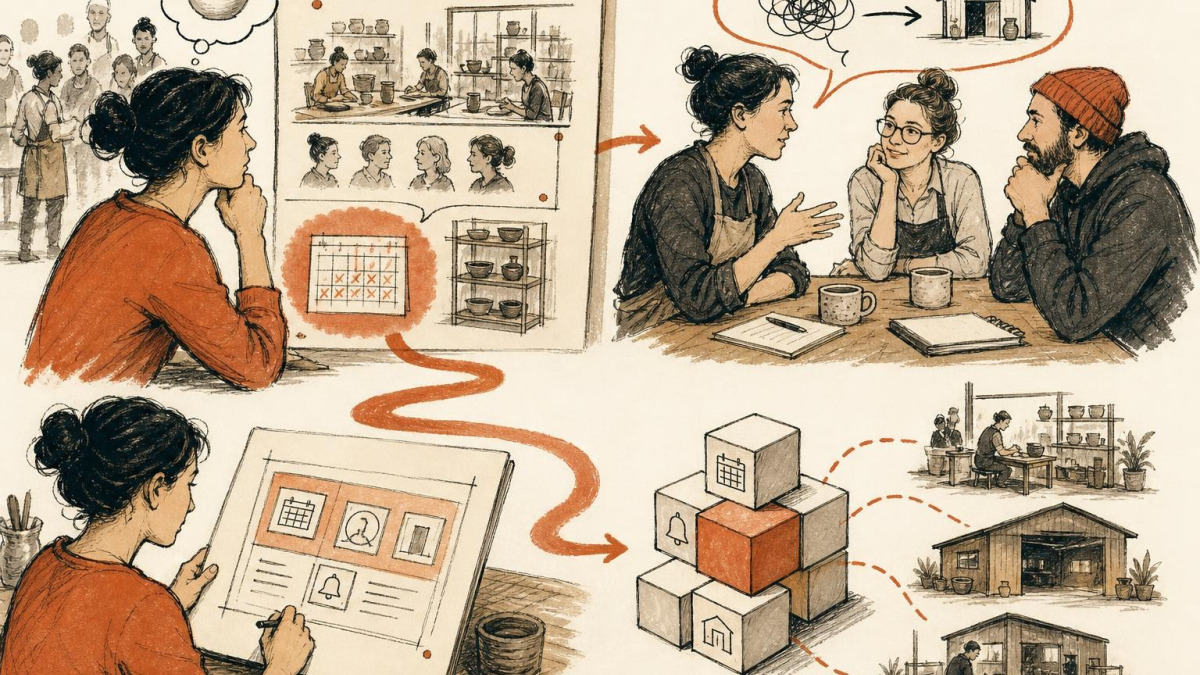
A clear audience gives an application a practical starting point: you can ask who needs it, what recurring task it could help with, and what would make it useful to them. “An app for everyone” is hard to explain. “A shared booking space for independent pottery studios” gives you a group to talk to and a problem to investigate. A discussion on X offers a useful prompt. Lily Ray’s post, published October 21, 2026, echoed a distribution concern raised in Daniel Foley Carter’s post, published October 20: people may prefer to build some tools themselves, while builders still need to find buyers. These individual posts are not market-wide evidence. The useful takeaway is to think about the audience and its need alongside the application idea—not to assume that building an app will bring customers. A niche is a starting hypothesis, not proof of demand. Before designing, speak with people in the group you have in mind. Find out how they handle the problem now, what makes that difficult, and whether a dedicated tool would help.
What could a niche application look like?
Illustrative example: imagine a small-business owner exploring a shared equipment-booking service for independent ceramics studios. The proposed application might help studio members see what equipment is available, request a time slot, and keep track of bookings. Those are ideas for a possible first version, not features claimed to be already built. To keep the concept useful, connect each proposed feature to a real user need. If members mainly struggle to find out whether a wheel or kiln is free, availability information may matter more than a large set of extra tools. If the owner also needs to coordinate access, that could become a question to explore with potential users. KAXXIS business modules provide project-specific screens, workflows, a data model, and integrations. That gives a creator a way to shape an application around a defined use case, rather than treating a general platform catalogue example as a complete app ready for customers.
- Name the people the application is for.
- Describe one recurring problem in their own terms.
- List only the first-version features that could address that problem.
- Ask potential users what is missing from the idea.
How does KAXXIS fit into the idea?
KAXXIS provides a platform foundation and a build kit to help create, license, translate, deploy, and upgrade an application. The business module is where the project-specific experience and workflows are defined. In the studio example, the creator would need to work out which screens and workflows suit the intended users; the example is a product concept, not a ready-made KAXXIS application. This can be relevant if you are a founder exploring a niche product, an agency developing a solution for a defined market, or a business team considering a useful internal application. KAXXIS’s site invites prospective creators to see what is already built and learn how modules deploy. Those are practical places to explore the platform before deciding how your own application idea might take shape.
What should you do before taking the idea further?
Turn the broad idea into a short conversation guide. Ask people in your intended audience how they handle the task today, where it causes friction, and what a helpful outcome would look like. Use what you learn to refine the proposed first version—not to presume that every requested feature belongs in it. A useful next step is to write a one-sentence concept: “For [a specific group], this application could help with [a recurring problem] by offering [a small set of proposed features].” Then explore KAXXIS’s existing modules and deployment information to understand the platform foundation behind a potential build. If your concept still feels too broad, narrow the audience or problem before adding more features.
- Audience: Who would use this application?
- Problem: What recurring task or frustration would it address?
- First version: Which proposed features respond directly to that problem?
- Next conversation: What do you need to learn from potential users?
News sources
- Webflow vs Vibe Coding: Which Is Better for a B2B SaaS Website? | ViDesigns – Webflow Agency — published 2026-10-26T12:22:30+00:00
- Lily Ray — published 2026-10-21T02:59:15+00:00
- Marc Lou on X: "Software is having its Uber moment. For years, SaaS companies could keep raising prices because building an alternative was too expensive. AI changes that. Now anyone can enter the market with a competitive pricing. And customers can vibe code a good-enough version themselves." / X — published 2026-10-20T03:29:25+00:00