Start with the coordination problem
When an order is late, time can disappear into checking the latest update, deciding who should respond and repeating the same information to the customer. Before choosing features, map what people need to know and do to move one delayed order forward. KAXXIS supplies a licensed runtime and Module SDK. Business modules can provide project-specific screens, workflows, data models and integrations. That gives a business owner a basis for scoping software around a real process—but catalogue examples are not finished applications automatically included in the licence. The useful first step is therefore to describe the work your team wants the software to support, not assume a tracker already exists.
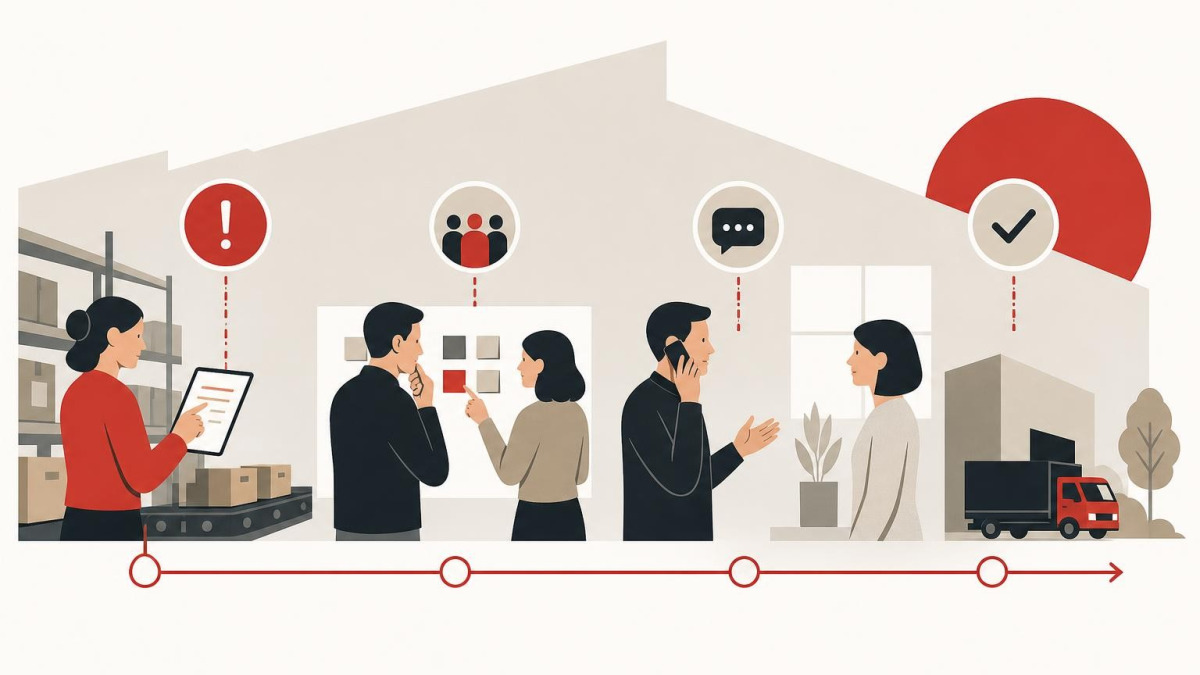
Illustrative example: follow one late delivery
Imagine a small business expecting a supplier delivery on Tuesday. On Wednesday, someone learns it has been delayed, but the person handling customer enquiries does not know the new estimate. This is an illustrative planning example, not a real customer case or a ready-made KAXXIS feature. Use the example to list what a tracker might need to record: the order reference, expected date, latest delivery update, who received that update, the person responsible for the next step, and when the customer was last contacted. Then map the decisions: does the team wait, contact the supplier again, inform the customer, or consider another option? Those are possible requirements to discuss, not claims about existing screens or workflows. Ask where each piece of information comes from. If the tracker needs to exchange data with an ordering system, payment service or external provider, write that down as a project requirement. Hosting, external-provider usage, payment integrations and bespoke development are separately configured or scoped; do not assume they are included by default.
Turn the example into clear handoffs
A useful plan should make the next action clear, not just collect status updates. Decide who owns the order when a delay is reported, what information they need to act, and what event means the issue is resolved. Also agree what the customer should be told and who is responsible for telling them. These are questions for your workflow design; the example does not prove that a finished tracker performs these steps. If the software will hold records for separate businesses or tenants, include access boundaries in the plan. A tenant is one business or customer’s separate area of data. The KAXXIS developer walkthrough calls for authorising endpoints and checking that one tenant cannot read or update another tenant’s records. In plain terms, separation should be specified and tested rather than assumed. When a prototype begins, the walkthrough recommends building the unmodified starter before making changes. That can help distinguish setup problems from issues introduced by later changes.
A scoping checklist for your next conversation
Bring one real delayed-order case to a project-scoping discussion. Keep the first conversation grounded in what happened, who needed to know, and what should have happened next. You do not need to arrive with a finished technical design; you do need to be clear about the business process and any systems the tracker may depend on. A module release on a managed host is staged by an authorised operator after review, then activated with a controlled host restart. Module code is trusted code running within the application, so it needs review. Deployment scope, support and updates are agreed in the proposal. These are useful points to clarify with the people responsible for development and deployment, rather than assumptions to make from the planning example.
- Write down the order’s expected date, latest update and source of that update.
- Name the person responsible for the next action and the customer communication.
- Agree what counts as resolved and what should happen if the estimate changes again.
- List the records and external systems the tracker may need to use.
- Ask how data access, review, deployment, support and updates will be handled.